
Falafel |
|
|---|---|
|
Like all the other longstanding traditional recipes, falafel has its regional variations and its favorite levels of spiciness. Some of those variations create more argument than others--for example, whether or not the world will come to an end if you start with canned chickpeas instead of dried, whether it's acceptable to make it with fava beans instead of chickpeas (or a combination of fava beans and chickpeas), how much garlic one must include, whether or not to include baking powder, and on and on. This recipe reflects my tastes, and you're free to increase or decrease the spices and garlic as you please. I list only chickpeas simply because they are easier to find. In my rural area, no one carries fava beans. But you can certainly substitute them for the chickpeas or use a combination of the two if you prefer.
|
|

1-1/2 cups dried chickpeas, soaked in water overnight (or three 14oz. cans of chickpeas, drained) 1 small onion or 1/2 medium onion, finely chopped 4 garlic cloves, minced 1/4 cup chopped fresh parsley 1/4 cup chopped fresh cilantro 1 tsp salt 1 tsp cumin 1/4 tsp chili powder Pinch of ground cardamom 1 tsp ground coriander 1/4 tsp freshly ground black pepper 1 tsp baking powder (optional), helps to achieve a lighter texture 1/4 cup plain or chickpea flour (optional, but may help to bind the ingredients if the balls fall apart in the hot oil) |
 |

If using dried chickpeas, put them in a bowl with enough water to cover them by at least an inch, as they will swell when they absorb the water. Soak them overnight and then drain in a colander or sieve.
Place the drained chickpeas and other ingredients (except for the flour) in your food processor and pulse until blended (but not completely pureed).
Place the mixture in a bowl, cover with a tea towel or bowl cover and refrigerate for at least a couple of hours. Form the mixture into small balls in your hands. If the balls will not hold together, you can stir in several tablespoons of flour, one at a time, to provide additional binding. Once you have made them a couple of times, you'll know whether you need the flour, and how much, and you can add that when you mix the ingredients in the food processor.
Heat oil in a medium saucepan or other heavy pot, and fry 1 ball to test. If it falls apart, you may need to add a little more flour. Fry just enough balls at one time to cover the surface of the oil, until golden brown. Or form into small patties (1-1/2" to 2" across) and bake for 25-30 minutes at 375F/180C. Turn each patty over at the halfway point.
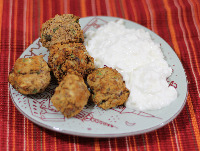
These can also be baked in an air fryer set at 350F/180C. In fact, the ones in the picture were cooked that way. You may have to make multiple batches. My small air fryer will hold about six at a time.
I love to have them with yogurt, though it's also traditional to serve them with chopped tomatoes, onions, additional fresh cilantro and sauerkraut. I didn't have any yogurt on hand when I shot these pictures, but did have some cottage cheese. So I can report that they're very good with cottage cheese as well. In fact, after taking the pictures, I had the plateful for lunch!