
| Bread Pudding |
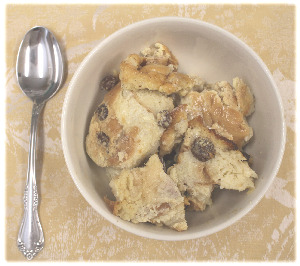
Bread pudding is one of those great old-fashioned recipes that almost everyone loves. But because it has been around for so long, there are wide variations in how it's made and in what people prefer. Some like a soft custard with just enough bread that you can tell it's there. Some want the bread to be the primary ingredient with just enough custard to hold it together. So the measurements in this version allow for some variation. I like something in the middle, so you can see the chunks of bread in the finished dish, but there is enough pudding that you can taste that as well. Adjust the amount of bread to suit your own preferences.
You may notice that this recipe doesn't require you to set the baking dish in a water bath to steam the pudding. Many recipes say that you must steam it, for various reasons--to moderate the oven heat or to keep the custard from curdling, or something else. Given the humble origins of bread pudding, I believe it's more likely a poor family would have used steaming in place of the oven that few of them would have had. I have never steamed my bread pudding and have never experienced curdling.
One other comment about the bread. This used to be the way one used up leftover bread that had gone stale. When I was small and my mother wanted to make bread pudding, we saved the heels of each loaf. When there were enough, we had our bread pudding. Now it's fashionable to say bread pudding must be made with challah or French bread or some other fancy bakery loaf. Don't believe it. Bread pudding is just fine with any bread that has some body to it. I wouldn't try to make it with that spongy white stuff because I don't consider that to be real bread to begin with. But if that's all you have, at least save out the heels and use those instead of the inner slices.

Pre-heat oven to 350° F (150° C).
Lightly grease an 8-inch square baking dish and set it aside.
In a large bowl, break the stale bread into small pieces (yeah, yeah, I know you're supposed to cut it into precise cubes--who has time for that!). In another bowl, beat the eggs until well mixed up. Add all the other ingredients except for the milk and raisins and mix until thoroughly blended. Add the milk in a slow steady stream, and mix with a fork or whisk until all the ingredients are combined. If you use the raisins, you can mix them evenly into the bread now, or just scatter them over the top after the milk and spices are added.
Pour the liquid over the bread, and mix very gently with your hands until all the bread is moistened. You may need to let it sit for a few minutes and then come back and mix it a bit more until all the liquid has soaked into the bread. Don't let it turn into mush, though! If you use the smaller amount of bread, just put the bread pieces straight into the baking pan and pour the custard mixture on top, because you won't be able to mix it with your hands.
Scatter your raisins over the top, if you didn't mix them in with the bread, and bake until a knife or skewer inserted near the center comes out clean, about 45-55 minutes. Or give the pan a little shake, to avoid having to open the oven door so far. If you see more than a slight quiver from the custard, it needs more time to cook. Serve warm (but it's good at any temperature).
 Must you use raisins? Of course not. But I'm firmly in the camp that says you must use nutmeg. Leave it out if you don't care for it, but I think it makes a subtle improvement in the flavor. In fact, I think one should always add nutmeg when cinnamon is in use. The two go together so perfectly that it's a shame to deny each one the other's company.
You can substitute other sweeteners. "Sugar" is a generic term. My parents didn't allow white sugar at home when I was growing up, so I make this with brown sugar or jaggery (raw sugar cane). Some recipes suggest half sugar and half maple syrup. I haven't tried that, but it sounds good. This recipe has much less sugar than most. I've seen some that called for two whole cups of sugar for the same amount of bread. Do your health a favor and use the least you can manage. You can substitute keto-friendly sugars such as tagatose or erythritol, though the taste will be slightly different. With the amount of bread in this, it's never going to qualify as a keto dessert. But you can at least lower the carbs with sugar substitutes. I have not tried making it with keto "bread" yet but when I do, I'll incorporate information about that in the recipe.
You may notice that this recipe doesn't require you to set the baking dish in a water bath to steam the pudding. Many recipes say that you must steam it, for various reasons--to moderate the oven heat or to keep the custard from curdling, or something else. Given the humble origins of bread pudding, I believe it's more likely a poor family would have used steaming in place of the oven that few of them would have had. I have never steamed my bread pudding and have never experienced curdling.
One other comment about the bread. This used to be the way one used up leftover bread that had gone stale. When I was small and my mother wanted to make bread pudding, we saved the heels of each loaf. When there were enough, we had our bread pudding. Now it's fashionable to say bread pudding must be made with challah or French bread or some other fancy bakery loaf. Don't believe it. Bread pudding is just fine with any bread that has some body to it. I wouldn't try to make it with that spongy white stuff because I don't consider that to be real bread to begin with. But if that's all you have, at least save out the heels and use those instead of the inner slices.

About 8-10 cups of stale bread, broken into small pieces 4 eggs 1/2 cup sugar 1/2 tsp. ground cinnamon 1/4 tsp. nutmeg 1/4 tsp. salt 3/4 tsp. vanilla extract 4 cups milk 1/3-1/2 cup dried cranberries or raisins |
|
Pre-heat oven to 350° F (150° C).
Lightly grease an 8-inch square baking dish and set it aside.
In a large bowl, break the stale bread into small pieces (yeah, yeah, I know you're supposed to cut it into precise cubes--who has time for that!). In another bowl, beat the eggs until well mixed up. Add all the other ingredients except for the milk and raisins and mix until thoroughly blended. Add the milk in a slow steady stream, and mix with a fork or whisk until all the ingredients are combined. If you use the raisins, you can mix them evenly into the bread now, or just scatter them over the top after the milk and spices are added.
Pour the liquid over the bread, and mix very gently with your hands until all the bread is moistened. You may need to let it sit for a few minutes and then come back and mix it a bit more until all the liquid has soaked into the bread. Don't let it turn into mush, though! If you use the smaller amount of bread, just put the bread pieces straight into the baking pan and pour the custard mixture on top, because you won't be able to mix it with your hands.
Scatter your raisins over the top, if you didn't mix them in with the bread, and bake until a knife or skewer inserted near the center comes out clean, about 45-55 minutes. Or give the pan a little shake, to avoid having to open the oven door so far. If you see more than a slight quiver from the custard, it needs more time to cook. Serve warm (but it's good at any temperature).
Must you use raisins? Of course not. But I'm firmly in the camp that says you must use nutmeg. Leave it out if you don't care for it, but I think it makes a subtle improvement in the flavor. In fact, I think one should always add nutmeg when cinnamon is in use. The two go together so perfectly that it's a shame to deny each one the other's company.
You can substitute other sweeteners. "Sugar" is a generic term. My parents didn't allow white sugar at home when I was growing up, so I make this with brown sugar or jaggery (raw sugar cane). Some recipes suggest half sugar and half maple syrup. I haven't tried that, but it sounds good. This recipe has much less sugar than most. I've seen some that called for two whole cups of sugar for the same amount of bread. Do your health a favor and use the least you can manage. You can substitute keto-friendly sugars such as tagatose or erythritol, though the taste will be slightly different. With the amount of bread in this, it's never going to qualify as a keto dessert. But you can at least lower the carbs with sugar substitutes. I have not tried making it with keto "bread" yet but when I do, I'll incorporate information about that in the recipe.